Book summary · honest review
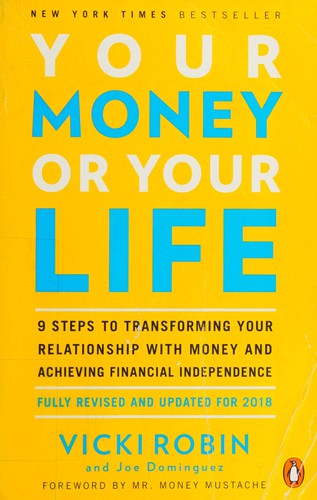
Your Money or Your Life
Vicki Robin & Joe Dominguez · first published 1992
The 1992 book that reframed money as hours of your life, and accidentally founded the FIRE movement.
What the book actually says
Long before financial independence had an acronym, Robin and Dominguez argued that money is something you trade your life energy for — every purchase costs hours of your finite time on earth. The book's nine-step program starts by making that trade visible: calculate your real hourly wage after subtracting commuting, work clothes, decompression time, and job-related spending, then price everything you buy in hours of your life. From there you track every dollar, ask whether each category of spending delivered fulfillment proportional to the life energy it consumed, and watch expenses fall naturally, without deprivation, as the answers get honest. The endpoint is the crossover moment when investment income exceeds monthly expenses and paid work becomes a choice. Dominguez had retired from Wall Street at 31 using this system, and the book's blend of practical tracking and quiet philosophy about what money is actually for made it a bestseller. Its fingerprints are on every FIRE blog written since, and Robin's revised editions have kept it in print for three decades.
Who it's for
For anyone who suspects their job is consuming the life it's supposed to fund, and for spenders who've failed at budgets because budgets never asked why. It's philosophy first, spreadsheet second.
The honest criticism
The original edition's investment plan — living off Treasury bond interest — was a product of 1980s rates and had to be rewritten in later editions, which undermines confidence in the program's mechanics. The meticulous every-dollar tracking also demands a temperament most readers won't sustain.
The 5 lessons worth keeping
- Your real hourly wage is lower than you think. Subtract commuting time, work expenses, and recovery time from your pay, and use that honest number to price everything you buy.
- Every purchase costs life energy, not just dollars. Translating a price tag into hours of your life is the fastest way to discover which spending you genuinely don't want.
- Fulfillment, not thrift, is the test for spending. Instead of asking whether you can afford something, ask whether it delivered satisfaction proportional to the life you traded for it.
- There is a point called enough, and more money past it doesn't help. Identifying your own enough turns saving from endless sacrifice into a project with a finish line.
- Financial independence arrives at a crossover point you can plot. When income from your savings covers your monthly expenses, work becomes optional — and tracking both lines shows you how far away that day is.
Try the book's big idea with your numbers
The book's first exercise is discovering what an hour of your life actually sells for — start with the salary to hourly calculator, then subtract your commute and see how the number shrinks.
Open the calculatorMore money books, summarized
Last reviewed August 31, 2026. Figures based on the book itself (Your Money or Your Life, Vicki Robin & Joe Dominguez, 1992); this page is independent commentary and is not affiliated with the author or publisher. Estimates for general education, not financial advice.