Which ones to read — and which to skip.
Which Money Book Should You Read?
Ten famous money books, and no time to read them all — and most were not written for the situation you are in this year anyway. This book works out five numbers with you, points you at the titles that fit those numbers, teaches the arithmetic that sits underneath all ten, and then gives each book its own chapter of review, original worked figures and honest criticism.
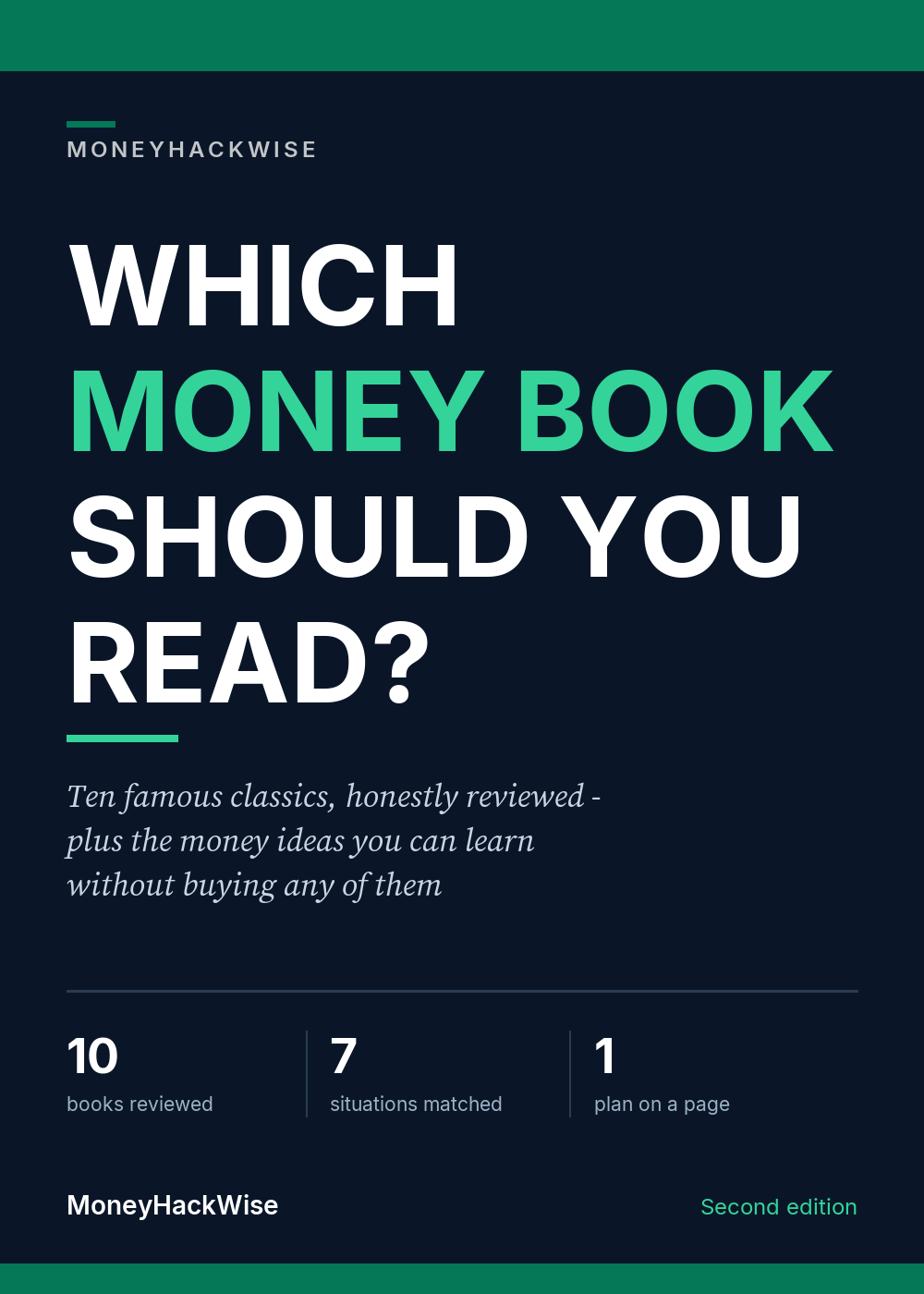
What's inside
- All ten titles reviewed, one chapter each: Rich Dad Poor Dad, The Psychology of Money, The Intelligent Investor, Think and Grow Rich, The Total Money Makeover, The Millionaire Next Door, I Will Teach You to Be Rich, The Simple Path to Wealth, Your Money or Your Life, and Die With Zero
- A chooser built on five numbers that cost nothing to work out — four in an evening, the fifth after thirty days of recording what you actually spend — sorting you into one of seven situations, each naming the book to read first, what to read after that (sometimes nothing), and the titles that would mislead you right now
- A seven-chapter primer on the standard money arithmetic all ten rely on: compounding, inflation, what debt really costs, savings rate, the 4% rule and sequence risk, good versus bad debt and fee drag, and lifestyle creep
- Every review built to the same seven-part shape — what the book argues, five things worth doing about it, an original worked table, who should read it, who should skip it, the honest criticism, and a verdict
- Worked arithmetic with the assumptions printed in each table's caption: snowball versus avalanche on a representative four-debt set, where both finish in month 30 and the friendlier order costs $636 more in interest; one percentage point of fees taking $107,728 out of a thirty-year pot; the same thirty returns reordered leaving $141,428 or $2,981,981 depending only on when the bad years land — illustrative arithmetic on stated assumptions, not forecasts
- A coverage grid scoring all ten against the eight topics we think a complete money education has to cover — no single title covers all eight — plus a two-book route, a six-book route, and a zero-book route that says plainly what you would still be missing
- Seven conclusions all ten authors reach independently, each with a number attached, and seven places where they flatly contradict each other, each settled by a short test about you rather than about the books
- A closing chapter of seven decisions with a ready-made default for each, a nine-line plan sheet shown blank and then filled in, and a one-glance table of all ten — author, year, chapter and what each one is, in a line
Frequently asked questions
Is this a summary of the ten books?
No. It reproduces no text, illustrations or other material from the ten books, and it is not a condensation of them or a substitute for reading them. It is independent commentary — a chapter of review, original worked arithmetic and criticism for each title — with no affiliation with, endorsement by, or authorisation from any of the authors or publishers. Where a chapter makes a book sound like the one you need, it tells you to go and buy it.
Do I need to have read any of them first?
No. Part II teaches the arithmetic from scratch — compounding, inflation, debt cost, savings rate, the 4% rule and sequence risk, good versus bad debt and fee drag, and lifestyle creep — so the reviews make sense whether you have read none of the books or all ten.
Does it include calculators, spreadsheets or templates?
No. Everything is printed in the book: the tables, twelve original diagrams, and a nine-line plan sheet you copy onto one sheet of paper. Every growth table names its return, compounding basis and timing, and the standing assumptions — 7% nominal compounded monthly, 3% inflation — are printed at the front and back, so you can check any figure or rerun it on your own assumptions in about ten minutes with any spreadsheet.
Is this financial advice?
No. Every worked example is in US dollars and the ideas behind them apply anywhere, but country-specific tax rules and account types are deliberately not attempted. Nothing here is personalised financial, investment or tax advice, and no figure is a forecast. The chooser is a fixed self-assessment — the same five numbers lead every reader down the same branch — not a recommendation tailored to your circumstances.
Planning disclaimer
These products are tools for personal planning, organization, and education only. They do not provide personalized financial, investment, tax, legal, or accounting advice.
Other templates
- Annual Budget & Expense Tracker — Auto-updating dashboard for your whole year.
- Monthly Bill & Subscription Tracker — See what your subscriptions really cost.
- Debt Payoff Planner — Snowball & avalanche, side by side.
- Savings Goals Tracker — Hit every goal on time.